ss_blog_claim=b1c8a347d19acb6069e7726e485dcc4d

Monday, November 30, 2009

Review: God Gave Us Chrstmas

Photobucket


As Little Cub and her family prepare to celebrate the most special day of the year, the curious young polar bear begins to wonder…
“Who invented Christmas?”
Mama’s answer only leads to more questions like “Is God more important than Santa?” So she and Little Cub head off on a polar expedition to find God and to see how he gave them Christmas. Along the way, they find signs that God is at work all around them. Through Mama’s gentle guidance, Little Cub learns about the very first Christmas and discovers that…
Jesus is the best present of all.
This enchanting tale provides the perfect opportunity to help young children celebrate the true meaning of Christmas and to discover how very much God loves them.

My rating: 5 of 5 stars

Whenever I search for a children's book dealing with Christmas time, it's always a challenge and question on whether or not to deal with a book about Santa or about Jesus. This wonderful little treasure from Lisa's God Gave Us series makes it where there is not a choice, but just truth. Here, Mama takes time to show Little Cub in detailed images why and how God gave us Christmas and intertwines how Santa fits into the picture. I love the poetry of the prose and the pictures are fabulous and colors are wonderful to look at. I truly enjoyed sharing this story with my daughter and look forward to reading it more and more in the years to come and highly recommend it!

View all my reviews >>

Find on Random House here.

Lisa Tawn Bergren is the award-winning author of nearly thirty titles, totaling more than 1.5 million books in print. She writes in a broad range of genres, from adult fiction to devotional.God Gave Us Love follows in Lisa’s classic tradition of the best-selling God Gave Us You. She lives in Colorado, with her husband, Tim, and their children, Olivia, Emma, and Jack.

Visit the author's website.

David Hohn is an award-winning illustrator who graduated with honors from the Maryland Institute College of Art. He has worked as both a staff artist and an art director for a children’s software company in Portland, Oregon, a position which led to his art directing an award-winning project for Fisher-Price. Hohn’s recent projects include Lisa Tawn Bergren’s God Gave Us Christmas.

Visit the illustrator's website.


I also really enjoy Lisa's adult Christian historical fiction as well as her other God Gave Us titles, such as God Gave Us Heaven. Read more… God Gave Us Heaven is one of the best children's book with the most important message that is often hard to explain. I love Lisa Tawn Bergren's adult fiction series and now I love her children's books as well and cannot wait to add others to my shelf. The pictures are wonderful and provide for much exploring and conversation. It is definitely a book I would recommend for my nieces and nephews.

*These books were provided for review by the WaterBrook Multnomah Publishing Group.*


Saturday, November 28, 2009

Review: The Christmas Kitchen

Photobucket

The Christmas Kitchen: The Gathering Place for Making Memories The Christmas Kitchen: The Gathering Place for Making Memories by Tammy Maltby

The Heart of the Home

Even in today's busy times, the kitchen is the heart of the home. Author Tammy Maltby believes the true meaning of Christmas is realized when families gather to share activities that make Christmas "the most wonderful time of the year." More than any other holiday, Christmas is when family and friends gather for a cup of hot chocolate, fresh-baked cookies, and lots of laughter.

Look inside this holiday treasure for:

- Easy-to-do holiday recipes

- Hints for new traditions

- Personal gift ideas

- Kid-friendly activities

- Simple decorating tips

The Christmas Kitchen is more than a recipe book, it's a book designed to help you enjoy the holiday season, not be burdened by it. Take a few minutes each day to browse these pages for the help you've been looking for.

Merry Christmas and may your kitchen be filled, first, with the sweet aroma of love, and then with the spices of the season.


My rating: 5 of 5 stars
What a delightful novelty this book is from Howard Books this CHRISTmas season. This square hardback book has come to me at the perfect time, where I am just really starting to have my own house and home to manage Christmas. Each chapter has tips and tricks on the Christmas Kitchen, making it a state of mind and working outward from there to make memories and more. Through out there are fabulous and yummy recipes and lists of ideas to make the season quite merry. As some can get over whelmed, this book gives the reader the best ideas of keeping the reason for the season and having a happy holiday. I love this little book and recommend it to anyone seeking ideas for enhancing or starting their Christmas Kitchen.

View all my reviews >>

*Special thanks to FIRST for making a copy available for review.*

Review: A Daughter's Inheritance

A Daughter's Inheritance (The Broadmoor Legacy #1) A Daughter's Inheritance by Tracie Peterson

Lose Yourself in the History, Opulence, and Elegance of the Thousand Islands Cousins Amanda, Sophie, and Fanny Broadmoor are as close as sisters, but when their grandfather dies, the terms of his will just might destroy their bond. Seventeen-year-old Fanny has never put much stock in the conventions of society. In fact, she has given her heart to Michael, the family boat-keeper. But when she receives a surprising inheritance, she discovers just how oppressive society can be... and that she may be trusting the wrong people. Dare she follow her heart and risk going against her family? What if she loses everything she's ever known? It all comes down to one choice: What does Fanny Broadmoor want her legacy to be?


My rating: 4 of 5 stars

As the first novel in a series, this is something that I am extremely eager to continue to the next novels. Many times if there is a series where questions are left unanswered for the next novels they are abrupt and annoying in their wait for answers. With this novel I find I have anticipation for the next book in the series, but I'm not left on a ledge in annoyance. I'm glad I've already purchased the second book, and received the third for a review - I cannot wait to read them.

This is an entertaining book. The main character, a Fanny Broadmoor has been dealt an interesting life within her extended family of loss after loss and with the issue of a possible inheritance she may be pushed even further away from them than she ever imagined. Once again Tracie Peterson has a novel with a bad guy that gets under your skin. But the difference this time is that this is a co-authored novel and this is a bad guy that you do not want to be bad. For my first exposure to Judith Miller, I must say I enjoyed it. After reading so many Peterson novels, I can tell a difference in the writing voice of this novel and I believe I have found another author in Miller to add to my reading list.

View all my reviews >>


Thankfully Reading Weekend


Friday, November 27, 2009

Christmas came early!

Sent from my Verizon Wireless BlackBerry

Thursday, November 26, 2009

Bravado Coupon!


The coupon code is: TH09-175 and is for 25% your entire online order at: www.bravadodesigns.com. The coupon expires at the end of day on Monday.


Wednesday, November 25, 2009

Wordless Wednesday

FIRST Chapter: A Novel Idea

Today's Wild Card authors are:

Various Best-Selling Authors
(contributions from best-selling authors including Jerry B. Jenkins, Francine Rivers, Karen Kingsbury, Randy Alcorn, Terri Blackstock, Robin Jones Gunn, Angela Hunt and more)

and the book:


A Novel Idea

Tyndale House Publishers, Inc. (November 1, 2009)

***Special thanks to Vicky Lynch of Tyndale House Publishers for sending me a review copy.***

ABOUT THE BOOK:


Best-selling Christian fiction writers have teamed together to contribute articles on the craft of writing. A Novel Idea contains tips on brainstorming ideas and crafting and marketing a novel. It explains what makes a Christian novel “Christian” and offers tips on how to approach tough topics. Contributors include Jerry B. Jenkins, Karen Kingsbury, Francine Rivers, Angela Hunt, and many other beloved authors. All proceeds will benefit MAI, an organization that teaches writing internationally to help provide literature that is culturally relevant.


Product Details:

List Price: $14.99
Paperback: 320 pages
Publisher: Tyndale House Publishers, Inc. (November 1, 2009)
Language: English
ISBN-10: 1414329946
ISBN-13: 978-1414329949

AND NOW...THE FIRST CHAPTER:


Chapter 1: Plot

The Plot Skeleton

Angela Hunt

Imagine, if you will, that you and I are sitting in a room with one hundred other authors. If you were to ask each person present to describe their plotting process, you’d probably get a hundred different answers. Writers’ methods vary according to their personalities, and we are all different. Mentally. Emotionally. Physically.

If, however, those one hundred novelists were to pass behind an X-ray machine, you’d discover that we all possess remarkably similar skeletons. Beneath our disguising skin, hair, and clothing, our skeletons are pretty much identical.

In the same way, though writers vary in their methods, good stories are composed of remarkably comparable skeletons. Stories with “good bones” can be found in picture books and novels, plays and films.

Many fine writers tend to carefully outline their plots before they begin the first chapter. On the other hand, some novelists describe themselves as “seat-of-the-pants” writers. But when the story is finished, a seat-of-the-pants novel will (or should!) contain the same elements as a carefully plotted book. Why? Because whether you plan it from the beginning or find it at the end, novels need structure beneath the story.

After mulling several plot designs and boiling them down to their basic elements, I developed what I call the “plot skeleton.” It combines the spontaneity of seat-of-the-pants writing with the discipline of an outline. It requires a writer to know where he’s going, but it leaves room for lots of discovery on the journey.

When I sit down to plan a new book, the first thing I do is sketch my smiling little skeleton.

To illustrate the plot skeleton in this article, I’m going to refer frequently to The Wizard of Oz and a lovely foreign film you may never have seen, Mostly Martha.

The Skull: A Central Character
The skull represents the main character, the protagonist. A lot of beginning novelists have a hard time deciding who the main character is, so settle that question right away. Even in an ensemble cast, one character should be featured more than the others. Your readers want to place themselves into your story world, and it’s helpful if you can give them a sympathetic character to whom they can relate. Ask yourself, “Whose story is this?” That is your protagonist.

This main character should have two needs or problems—one obvious, one hidden—which I represent by two yawning eye sockets.

Here’s a tip: Hidden needs, which usually involve basic human emotions, are often solved or met by the end of the story. They are at the center of the protagonist’s “inner journey,” or character change, while the “outer journey” is concerned with the main events of the plot. Hidden needs often arise from wounds in a character’s past.

Consider The Wizard of Oz. At the beginning of the film, Dorothy needs to save her dog from Miss Gulch, who has arrived to take Toto because he bit her scrawny leg—a very straightforward and obvious problem. Dorothy’s hidden need is depicted but not directly emphasized when she stands by the pigpen and sings “Somewhere Over the Rainbow.” Do children live with Uncle Henry and Aunt Em if all is fine with Mom and Dad? No. Though we are not told what happened to Dorothy’s parents, it’s clear that something has splintered her family and Dorothy’s unhappy. Her hidden need, the object of her inner journey, is to find a place to call home.

Mostly Martha opens with the title character lying on her therapist’s couch and talking about all that is required to cook the perfect pigeon. Since she’s in a therapist’s office, we assume she has a problem, and the therapist addresses this directly: “Martha, why are you here?”

“Because,” she answers, “my boss will fire me if I don’t go to therapy.” Ah—obvious problem at work with the boss. Immediately we also know that Martha is high-strung. She is precise and politely controlling in her kitchen. This woman lives for food, but though she assures us in a voice-over that all a cook needs for a perfectly lovely dinner is “fish and sauce,” we see her venture downstairs to ask her new neighbor if he’d like to join her for dinner. He can’t, but we become aware that Martha needs company. She needs love in her life.

Connect the Skull to the Body: Inciting Action
Usually the first few chapters of a novel are involved with the business of establishing the protagonist in a specific time and place, his world, his needs, and his personality. The story doesn’t kick into gear, though, until you move from the skull to the spine, a connection known as the inciting incident.

Writers are often told to begin the story in medias res, or in the middle of the action. This is not the same as the Big Incident. Save the big event for a few chapters in, after you’ve given us some time to know and understand your character’s needs. Begin your story with an obvious problem—some action that shows how your character copes. In the first fifth of the story we learn that Dorothy loves Toto passionately and that Martha is a perfectionist chef. Yes, start in the middle of something active, but hold off on the big event for a while. Let us get to know your character first . . . because we won’t gasp about their dilemma until we know them.

In a picture book, the inciting incident is often signaled by two words: One day . . . Those two words are a natural way to move from setting the stage to the action. As you plot your novel, ask yourself, “One day, what happens to move my main character into the action of the story?” Your answer will be your inciting incident, the key that turns your story engine.

After Dorothy ran away, if she’d made it home to Uncle Henry and Aunt Em without incident, there would have been no story. The inciting incident? When the tornado picks Dorothy up and drops her, with her house, in the land of Oz.

The inciting incident in Mostly Martha is signaled by a ringing telephone. When Martha takes the call, she learns that her sister, who was a single mother to an eight-year-old girl, has been killed in an auto accident.

Think of your favorite stories—how many feature a hero who’s reluctant to enter the special world? Often—but not always—your protagonist doesn’t want to go where the inciting incident is pushing him or her. Obviously, Martha doesn’t want to hear that her sister is dead, and she certainly doesn’t want to be a mother. She takes Lina, her niece, and offers to cook for her (her way of showing love), but Lina wants her mother, not gourmet food.

Even if your protagonist has actively pursued a change, he or she may have moments of doubt as the entrance to the special world looms ahead. When your character retreats or doubts or refuses to leave the ordinary world, another character should step in to provide encouragement, advice, information, or a special tool. This will help your main character overcome those last-minute doubts and establish the next part of the skeleton: the goal.

The End of the Spine: The Goal
At some point after the inciting incident, your character will establish and state a goal. Shortly after stepping out of her transplanted house, Dorothy looks around Oz and wails, “I want to go back to Kansas!” She’s been transported over the rainbow, but she prefers the tried and true to the unfamiliar and strange. In order to go home, she’ll have to visit the wizard in the Emerald City. As she tries to meet an ever-shifting set of subordinate goals (follow the yellow brick road; overcome the poppies; get in to see the wizard; bring back a broomstick), her main goal keeps viewers glued to the screen.

This overriding concern—will she or won’t she make it home?—is known as the dramatic question. The dramatic question in every murder mystery is, Who committed the crime? The dramatic question in nearly every thriller is, Who will win the inevitable showdown between the hero and the villain? Along the way readers will worry about the subgoals (Will the villain kill his hostage? Will the hero figure out the clues?), but the dramatic question keeps them reading until the last page.

Tip: To keep the reader involved, the dramatic question should be directly related to the character’s ultimate goal. Martha finds herself trying to care for a grieving eight-year-old who doesn’t want another mother. So Martha promises to track down the girl’s father, who lives in Italy. She knows only that his name is Giuseppe, but she’s determined to find him.

The Rib Cage: Complications
Even my youngest students understand that a protagonist who accomplishes everything he or she attempts is a colorless character. As another friend of mine is fond of pointing out, as we tackle the mountain of life, it’s the bumps we climb on! If you’re diagramming, sketch at least three curving ribs over your spine. These represent the complications that must arise to prevent your protagonist from reaching his goal.

Why at least three ribs? Because even in the shortest of stories—in a picture book, for instance—three complications work better than two or four. I don’t know why three gives us such a feeling of completion, but it does. Maybe it’s because God is a Trinity and we’re hardwired to appreciate that number.

While a short story will have only three complications, a movie or novel may have hundreds. Complications can range from the mundane—John can’t find a pencil to write down Sarah’s number—to life-shattering. As you write down possible complications that could stand between your character and his ultimate goal, place the more serious problems at the bottom of the list.

The stakes—what your protagonist is risking—should increase in significance as the story progresses. In Mostly Martha, the complications center on this uptight woman’s ability to care for a child. Lina hates her babysitter, so Martha has to take Lina to work with her. But the late hours take their toll, and Lina is often late for school. Furthermore, Lina keeps refusing to eat anything Martha cooks for her.

I asked you to make the ribs curve because any character that runs into complication after complication without any breathing space is going to be a weary character . . . and you’ll weary your reader with this frenetic pace. One of the keys to good pacing is to alternate your plot complications with rewards. Like a pendulum that swings on an arc, let your character relax, if only briefly, between disasters.

Along the spiraling yellow brick road, Dorothy soon reaches an intersection (a complication). Fortunately, a friendly scarecrow is willing to help (a reward). They haven’t gone far before Dorothy becomes hungry (a complication). The scarecrow spots an apple orchard ahead (a reward). These apple trees, however, resent being picked (a complication), but the clever scarecrow taunts them until they begin to throw fruit at the hungry travelers (a reward).

See how it works? Every problem is followed by a reward that matches the seriousness of the complication. Let’s fast-forward to the scene where the balloon takes off without Dorothy. This is a severe complication—so severe it deserves a title of its own: the bleakest moment. This is the final rib in the rib cage, the moment when all hope is lost for your protagonist.

The Thighbone: Send in the Cavalry
At the bleakest moment, your character needs help, but be careful how you deliver it. The ancient Greek playwrights had actors representing the Greek gods literally descend from the structure above to bring their complicated plot knots to a satisfying conclusion. This sort of resolution is frowned upon in modern literature. Called deus ex machina (literally “god from the machine”), this device employs some unexpected and improbable incident to bring victory or success. If you find yourself whipping up a coincidence or a miracle after the bleakest moment, chances are you’ve employed deus ex machina. Back up and try again, please.

Avoid using deus ex machina by sending two types of help: external and internal. Your character obviously needs help from outside; if he could solve the problem alone, he would have done it long before the bleakest moment. Having him conveniently remember something or stumble across a hidden resource smacks of coincidence and will leave your reader feeling resentful and cheated.

So send in the cavalry, but remember that they can’t solve the protagonist’s problem. They can give the protagonist a push in the right direction; they can nudge; they can remind; they can inspire. But they shouldn’t wave a magic wand and make everything all right.

For Dorothy, help comes in the form of Glenda the Good Witch, who reveals a secret: The ruby slippers have the power to carry her back to Kansas. All Dorothy has to do is say, “There’s no place like home”—with feeling, mind you—and she’ll be back on the farm with Uncle Henry and Auntie Em. Dorothy’s problem isn’t resolved, however, until she applies this information internally. At the beginning of the story, she wanted to be anywhere but on the farm. Now she has to affirm that the farm is where she wants to be. Her hidden need—to find a place to call home—has been met.

In Mostly Martha, the bleakest moment arrives with Lina’s father, Giuseppe. He is a good man, and Lina seems to accept him. But after waving good-bye, Martha goes home to an empty apartment and realizes that she is not happy with her controlled, childless life. She goes to Marlo, the Italian chef she has also begun to love, and asks for his help.

The Kneecap and Lower Leg: Make a Decision, Learn a Lesson
Martha realizes that her old life was empty—she needs Lina in her life, and she needs Marlo. So she and Marlo drive from Germany to Italy to fetch Lina and bring her home.

You may be hard-pressed to cite the lesson you learned from the last novel you read, but your protagonist needs to learn something. This lesson is the epiphany, a sudden insight that speaks volumes to your character and brings them to the conclusion of their inner journey.

James Joyce popularized the word epiphany, literally the manifestation of a divine being. (Churches celebrate the festival of Epiphany on January 6 to commemorate the meeting of the Magi and the Christ child.) After receiving help from an outside source, your character should see something—a person, a situation, or an object—in a new light.

When the scarecrow asks why Glinda waited to explain the ruby slippers, the good witch smiles and says, “Because she wouldn’t have believed me. She had to learn it for herself.” The scarecrow then asks, “What’d you learn, Dorothy?” Without hesitation, Dorothy announces that she’s learned a lesson: “The next time I go looking for my heart’s desire, I won’t look any farther than my own backyard.” She has learned to appreciate her home, so even though she is surrounded by loving friends and an emerald city, Dorothy chooses to return to colorless Kansas. She hugs her friends once more, then grips Toto and clicks her heels.

The Foot: The Resolution
Every story needs the fairy-tale equivalent of “and they lived happily ever after.” Not every story ends happily, of course, though happy endings are undoubtedly popular. Some protagonists are sadder and wiser after the course of their adventure. But a novel should at least leave the reader with hope.

The resolution to Mostly Martha is portrayed during the closing of the film. As the credits roll, we see Marlo and Martha meeting Lina in Italy; we see Martha in a wedding gown (with her hair down!) and Marlo in a tuxedo; we see a wedding feast with Giuseppe, his family, and Martha’s German friends; we see Martha and Marlo and Lina exploring an abandoned restaurant—clearly, they are going to settle in Italy so Lina can be a part of both families. In the delightful final scene, we see Martha with her therapist again, but this time he has cooked for her and she is advising him.

Many movies end with a simple visual image—we see a couple walking away hand in hand, a mother cradling her long-lost son. That’s all we need to realize that our main character has struggled, learned, and come away a better (or wiser) person. As a writer, you’ll have to use words, but you can paint the same sort of reassuring picture without resorting to “and they lived happily ever after.”

Your story should end with a changed protagonist—he or she has gone through a profound experience and is different for it, hopefully for the better. Your protagonist has completed an outer journey (experienced the major plot events) and an inner journey that address some hurt from the past and result in a changed character.

What Next?
Now that we’ve reached the foot of our story skeleton, we’re finished outlining the basic structure. Take those major points and write them up in paragraph form. Once you’ve outlined your plot and written your synopsis, you’re ready to begin writing scenes. Take a deep breath, glance over your skeleton, and jump in.


Taken from A Novel Idea by ChiLibras. Copyright ©2009 by ChiLibras. Used with permission from Tyndale House Publishers. All rights reserved.

This is such a fabulous resource. I must confess, as I think many book bloggers secretly has a deep desire to one day write a book of their own. This book is divided into perfect chapters that really have the best advice on writing inspiration fiction from authors with writing that I know and trust. From the initial idea of plot all the way into the issues of marketing this book really contains the best introduction for wanna-bees like me as well as those who are already started well into the process. I'm sure this is a book I'll return to time after time. The best part about it all in my opinion is through out all of the processes they keep the most important focus on how God fits in it and that just makes me smile to have such a great resource. I highly recommend this great tool.

Tuesday, November 24, 2009

Product Review: Lamaze Spin and Explore Mat

The Spin & Explore Mat puts a unique spin on tummy time play, an important developmental phase for all newborns. Babies gently and comfortably spin round on their tummies, stretching and building upper bodies while exploring lots of squeaky, crinkly, tactile fun. DIMENSIONS: 14" X 17.25" X 6"

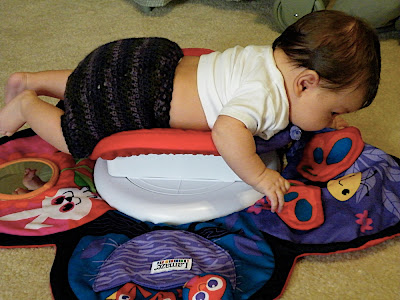
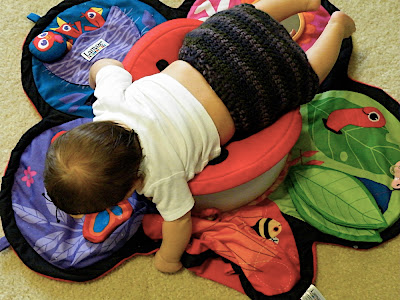
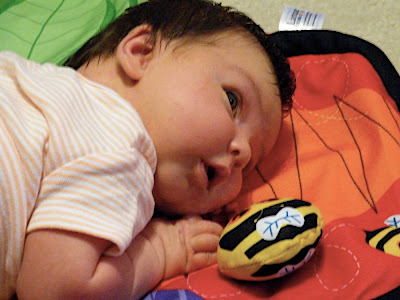
Another gift that we received when AppleBlossom was born from some coworkers of my husband was the Lamaze Spin and Explore Mat. You gotta love this ladybug! The leaves near the earthworm and the wings of the butterfly crinkle and they are definitely the favorite parts for AppleBlossom, yet more and more she is finding another interesting piece. She cannot squeeze it, but she loves to hear me squeeze the birdie who will then chirp for her. Also she loves to hear the bumblebee buzz his rattle. Then it almost goes without saying how she is enjoying the mirror. At first she would just be still and look, now she grasps the mat and kicks with her legs and pulls herself round. It is so fun to watch her learn and grow!

  • Place your infant on his/her stomach on the Spin & Explore Mat for tummy time. At first take off the spin seat. This will strengthen neck muscles and improve head control, which makes this a great baby toy.
  • Get down on the floor with your child. Your baby will love to see you at his level encouraging them to pull and tug at the different colors and animals. This will develop fine motor skills, as well as visual abilities.
  • When your child starts to hold their head up better put the spin seat on the mat and they will have fun spinning and exploring all the crinkles and textures on the mat.
  • Play peek-a-boo with your child by showing him/her how to hide the toys in the pockets or how to lift up the butterflies wings.
  • At about 5 or 6 months when your baby can sit up remove the spinner and it’s a great play mat they can still explore and play with.

  • I absolutely love the intelligent design of this toy with making the birdie squeak/chirp and the bumblebee rattle/buzz as they do in real life. I find that highly educational and praise the design. It is far less confusing that such toys that have purple zebras and such.

    Age: Newborns+ (Target Age: 3 months)

    Target Age

    Children grow and learn at different speeds. This item can be enjoyed by younger and older children depending on their interests and abilities.

    The Target Age is the time most children START enjoying this toy, game or book as determined by our Child-Experts.

    Please be aware of small-part warnings when choosing toys for younger children.

    Brand: Lamaze


    You can buy your own at ebeanstalk.com. It's another Expert recommended toy!

    Saturday, November 21, 2009

    Review: So You Want to Be a WAHM

    So You Want to Be a Work-At-Home Mom: A Christian's Guide to Starting a Home-Based Business So You Want to Be a Work-At-Home Mom: A Christian's Guide to Starting a Home-Based Business by Jill Hart

    Home-based businesses are estimated to be a $427 billion-a-year industry. In recent studies it was found that as many as 105 million people in North America alone were working at home. Considering this information, it is obvious that home-based businesses can be successful and authors Jill Hart and Diana Ennen will help you succeed with your own.

    So You Want to Be a Work-at-Home Mom details all the basics of starting a business in a spiritual, motivational, and comprehensive manner. From deciding what type of business to start to keeping your family and faith first, this helpful tool details every aspect of establishing a business. With proven success tips utilized by the authors and others who own work-at-home businesses, this inspiration approach will provide you with the resources you need to start your own home-based business.

    So You Want to Be a Work-at-Home Mom includes:
    Detailed information on types of businesses to start
    Ideas and assistance for setting up, operating, and marketing your business
    Definitions and descriptions of work-at-home terminology and processes
    Help for developing your Web site
    Explanations of the business nuts and bolts, including bookkeeping, taxes, and more

    My rating: 4 of 5 stars

    What a neat and useful tool this book is. Many different audiences can benefit from parts of this text for instance if you are like me considering the idea of a home-based business or for others who have already taken the leap. Authors Jill Hart and Diana Ennen kindly and with great tips guide the reader into specifics of what will be needed from a person to run a business from home, various types of businesses. All throughout they focus on faith and family first and talk about the difficulties but the benefits if you are successful. I am entirely grateful that I read this one as it gave me several ideas to file. After much prayer and consideration this is one that I'll come back to, to read some of the chapters with more deliberation and goal focus. I highly recommend this.

    View all my reviews >>

    Click here to go back and read the first chapter.

    Available at www.beaconhillbooks.com or by calling 1-800-877-0700.

    *Thanks to the authors through FIRST Wild Card for providing a copy for review.*

    FIRST Chapter: Love Finds You in Lonesome Prairie

    It is time for a FIRST Wild Card Tour book review! If you wish to join the FIRST blog alliance, just click the button. We are a group of reviewers who tour Christian books. A Wild Card post includes a brief bio of the author and a full chapter from each book toured. The reason it is called a FIRST Wild Card Tour is that you never know if the book will be fiction, non~fiction, for young, or for old...or for somewhere in between! Enjoy your free peek into the book!

    You never know when I might play a wild card on you!


    Today's Wild Card authors are:


    and the book:


    Love Finds You In Lonesome Prairie, Montana

    Summerside Press (December 1, 2009)

    ***Special thanks to Amy Lathrop of LitFUSE Publicity Group for sending me a review copy.***

    ABOUT THE AUTHOR:


    Tricia Goyer was named Mount Hermon Christian Writers Conference "Writer of the Year" in 2003. Her book Night Song won Book of the Year from ACFW in the Long Historical Fiction category. Her book Life Interrupted: The Scoop On Being a Young Mom was a Gold Medallion Finalist. Tricia has written hundreds of articles, Bible Study notes, and both fiction and non-fiction books.

    Visit the author's website.


    Ocieanna Fleissis a published writer and has edited six of Tricia Goyer's historical novels. She lives with her husband and their four children in the Seattle area. Connect with Ocieanna on Facebook!


    Product Details:

    List Price: $12.99
    Paperback: 320 pages
    Publisher: Summerside Press (December 1, 2009)
    Language: English
    ISBN-10: 1935416294
    ISBN-13: 978-1935416296

    AND NOW...THE FIRST CHAPTER:


    The sound of little girls’ voices and the sight of the sun streaming through the tall, second-story window of the Open Door Home for Destitute Girls, a privately owned orphanage on upper Manhattan, told nineteen-year-old Julia Cavanaugh that the day had started without her. Julia, an orphan herself, now running the place for the owner, brushed a strand of dark hair from her eyes. She submitted to a second yawn as a twelve-year-old girl hopped onto her bed.

    “He’s gonna ask her to marry him, don’t you think, Miss Cavanaugh?”

    “Oh, Shelby.” Julia wiped the sleep from her eyes and smiled into the freckled face staring eagerly at her. “Give me a moment to wake before you go asking such things.” Julia stroked the girl’s cheek, her heart seeming to double within her chest with love for the youngster.

    The embroidery sampler she’d fallen asleep working on still lay at the end of her bed. She picked it up and eyed the image of a small house she’d copied from Godey’s Lady’s Book. Above the house, she’d stitched the words Home Sweet Home in fancy script. Gazing around the broad room lined with small metal cots and bustling with little-girl chatter, Julia noted the embroidered pillowslips, carefully pressed—albeit dingy—curtains, and dandelions smiling from scavenged jam-jar vases. She’d done her best to make the room pleasant for the girls—and herself. She glanced at their faces and smiled, gladly embracing her role as caretaker.

    A less-than-subtle “ahem” from Shelby reminded Julia she’d been asked a question. She glanced at her young charge, still perched on the end of her bed. “What did you ask?”

    “Finally.” Shelby eyed her with mock frustration. “I said, do you think they will get married—Mrs. Hamlin and Mr. Gaffin? Haven’t you noticed the way they look at each other?” Shelby’s cheeks hinted of red. Her golden hair was already fixed in a proper bun, her hands and face washed, and her simple dress clean and pressed despite its patches and stray threads.

    “Shelby Bruce.” Julia shook her head, as Shelby’s two-year-old sister Beatrice wiggled onto Julia’s lap with a squeal. Julia planted a firm kiss on the top of Bea’s head.

    “Married? I don’t think so,” Julia continued. “Mrs. Hamlin would’ve told us—told me—if she was being courted. Mr. Gaffin’s just an old family friend.” Julia wondered where on earth the girl got the notion that their headmistress wished to marry.

    Although they have been spending a lot of time together. Julia pushed the thought out of her mind as little Bea shuffled to a stand, planting her pint-sized feet on Julia’s thighs. “Fammy fend!” She pointed a chubby finger at her older sister, Shelby.

    “All right, Bea.” Julia plopped the toddler on the floor and swiveled her toward the small bed she shared with Shelby. “Time to straighten your bed.” Then Julia eyed the twins. “Charity, Grace, would you two virtuous girls fetch fresh water for the basin?”

    Shelby pushed away from the bed, wrinkled her brow, and thrust her hand behind her as if to support her back—a perfect imitation of their middle-aged headmistress. “Now where did I put my spectacles?” Shelby clucked her tongue as she waddled forward.

    Laughter spilled from the lips of the girls around the room. Encouraged, Shelby scratched her head. She plopped down on her bed then hopped up again as if surprised, pulling imaginary spectacles from under her rump. “Oh!” she squealed. “There they are.”

    The laughter grew louder, and Julia pursed her lips together to smother the impulse to laugh along with them. She planted her fists on her hips. “That’s enough. All of you know what must be done before breakfast.” The girls’ laughter quieted to soft giggles hidden behind cupped palms as they scattered to do their chores.

    Shelby lingered behind, her form now straight and her eyes pensive. “Maybe she forgot to tell you, Miss Cavanaugh.” The young girl gazed up at her. “The way they look at each other—it’s like my ma and pa used to, that’s all.”

    Julia folded a stray sandy blond curl behind the girl’s ear. “Don’t worry, my sweet. If Mrs. Hamlin was getting married, we’d be the first to know.”

    Julia hoped her own gaze didn’t reflect the sinking disquiet that draped her. Mr. Gaffin was a rich world traveler. If there was any truth to Shelby’s suspicion, Julia couldn’t imagine he’d let Mrs. Hamlin continue to work with orphans. Perhaps they’d get a new headmistress.

    Or maybe the girls would be separated, moved to new homes…

    If Mrs. Hamlin got married, all their lives would be radically changed. And if Julia had to leave the orphanage, she had no idea what she would do. Julia swept that painful thought away and steadied her gaze at Shelby. She couldn’t hide her true feelings from this girl. Julia took Shelby’s hand and answered as honestly as she could.

    “I don’t think she’ll get married, but if she does, God will take care of us, like He always has.” Julia lifted her chin in a smile. “And really, Mrs. Hamlin may be forgetful, but no one could forget that. I sure wouldn’t.”

    Ardy, a shy Swedish girl, removed her dirty sheets from a small bed and then approached, taking Julia’s hand. “Don’t ya think you’ll ever be gettin’ married?”

    “Actually, there is something I’ve been wanting to tell you all….” Julia leaned forward, resting her hands on her knees.

    The two girls eyed each other in surprise, and Shelby’s brow furrowed.

    “Come closer.” Julia curled a finger, bidding them.

    “What is it?” Shelby asked, her eyes glued to Julia.

    The girls leaned in. “I’d like to tell you…that there’s a wonderful man who’s asked me to marry him!”

    The squeals of two girls erupted, followed by the cheers of nearly three dozen others who’d been quietly listening from the stairwell.

    “There is?” Shelby reached forward and squeezed Julia’s hand.

    Julia let out a hefty sigh and giggled. “No, you sillies. Well, at least not yet. Someday. Maybe.”

    Shelby pouted “But you said… ”

    “I said I’d like to tell you I had a man. I’d sure like to, but of course since I don’t, I’m happy to stay here with all of you.”

    The girls moaned.

    The squeak of the front door down on the first floor of the Revolutionary War–era home-turned-orphanage drew their attention. They waited as Mrs. Hamlin’s familiar chortle filled the air, along with a bash and clang of items—hopefully food and supplies that she’d picked up.

    “Julia!” Mrs. Hamlin yelped. “Julia, dear, where are you?”

    “Coming.” Julia hurried down the stairs to help the older woman.

    Julia neared the bottom of the steps and paused, trying to stifle a laugh at the sight of the twinkly-eyed woman sprawled flat on her back. Scattered boxes and bags covered the donated rug.

    “Mrs. Hamlin! What on earth? Why didn’t you get a steward to help you?”

    “Oh, I didn’t want to be a bother.” She cheerfully picked herself up. “I was in such a hurry to show you all what I’d bought. And to tell you my surprise. Such a wonderful surprise.” Julia eyed the boxes and noted they were from R.H. Macy & Co. More than a dozen boxes waited to be opened, and she couldn’t imagine the cost.

    “I found just what the girls need, and on sale!” the headmistress exclaimed.

    What they need is more food—vitamin drops, too—and maybe a few new schoolbooks. But Julia didn’t dare say it. And somehow God’s hand of providence always provided.

    “New clothes, I gather. That is a surprise.”

    “But only half of it, dear.” Mrs. Hamlin rubbed her palms expectantly. “I also must tell you my news. The best news an old widow could hope for.”

    Julia followed Mrs. Hamlin’s gaze toward the idle youngsters who’d gathered on the staircase to watch. Her eyes locked with Shelby’s, then she quickly looked away. “News?” The muscles in Julia’s stomach tightened.

    “Girls,” Julia shooed them away with a wave of her hand, “you know better than to eavesdrop. Off to chores with you. We’ll have breakfast soon.”

    The girls started to scurry off, but Mrs. Hamlin halted them with her words.

    “No, no,” her high-pitched voice hailed. “Come back. This news is for all of you.” They circled around her, and she tenderly patted their bobbing heads.

    “What is it?” Julia wasn’t sure she’d ever seen Mrs. Hamlin’s cheeks so rosy or her eyes so bright.

    “I’m getting married!”


    Never did receive a review copy, but that doesn't affect the fact that I recommend this book/series. I'll be looking for this one myself to read.

    Friday, November 20, 2009

    Thomas Nelson "first novels" $2.99


    I just read about the neatest thing on the Thomas Nelson Newsroom. Click here to go read more about it.

    Nashville, TN—Thomas Nelson Fiction announces a new line of “first novels” available for a short time exclusively through Christian retail accounts at just $2.99 each. Billed as an ideal way to sample an author, each of the selections is the first in a bestselling series—titles that typically retail for $14.99.


    Product Review: Graco Classic Pooh Let's Fly a Kite Swing


    Thanks to my sisters-in-law AppleBlossom has a Graco Classic Pooh Let's Fly a Kite Swing. It is a lifesaver! There are times when being on her back does not work, being held does not work, and tummy naps are no longer an option. When my whits-end is coming and she just is so unhappy, that is only one of the times when the swing has been so useful. Other times she is eager for it and enjoys the movement and looking around the room. Sometimes she will fall asleep in the swing and then stay out for longer naps that are fabulous for Mama time. I will scoop her up while she's out and put her down in the crib and when she wakes up she is all smiles and cooes.

    The infant head support is great for supporting her neck when she is soundly asleep and for when she was smaller and not quite able to support her neck herself. The 5-point harness keeps her secure where I never have to worry about her toppling sideways or otherwise. At this time, she will look at the mirror, but does not really interact with the spinning ball, but in the future as she grows I expect she will.

    At one point we had something wrong with the motor making a squealing noise, I contacted Graco and within two weeks they had us taken care of. I could not be happier with our entire experience thus far with this swing. I highly recommend it to any and everybody.

    • Compact, easy to move frame
    • One-hand, 4-position recline adjusts for baby’s comfort
    • 3-Point harness converts to 5-Point harness to keep baby secure
    • Variable speed lets you select the exact speed that’s right for your baby
    • Removable infant head support for additional comfort and fit
    • Easy Entry™ tray opens with one hand for easy access
    • 2 Mix ‘N Move® Toys provide stimulation for baby
    • Machine washable seat pad
    • Easy fold with red push levers
    • Runs up to 100 hours with 4 alkaline “C” cell batteries (sold separately)
    • For babies from 5.5 to 25 lbs
    • Machine wash cloth seat pad in cold water on delicate cycle. Line dry.
    • Clean metal and plastic parts with household soap and warm water
    • Never use bleach
    • Weight: 11.04 lbs.


    Manufacturer Suggested Age:
    : 0-6 Months


    We like our Tales of Avonlea.

    Talking @ 4 months old

    What does your four month old baby say?


    Sent from my Verizon Wireless BlackBerry

    Product Review: Sleep Sheep on the Go

    During our time of unemployment right after AppleBlossom was born we were not much into buying her things, but there were some things that we compromised on. One was that I was dying to have one of these Cloud B Sleep Sheep. We were in the educational toy store and this was the first real thing that I wanted to buy for her, so we compromised. Instead of getting the full sized real Sleep Sheep, we bought the Sleep Sheep on the Go. We use it everywhere!!


    NEW! Sleep Sheep On The Go - Compact Sound Machine for Life On The Go
    National Parenting Publications 2007 Nappa Gold Award


    A compact version of the award-winning original Sleep Sheep, this adorable travel companion brings its comforting sleep time sounds with you when you are away from home. Similar to the original Sleep Sheep, the On The Go version has four soothing sounds to help your child sleep easier; however its convenient size (8" tall) fits easily in a diaper bag or luggage. On The Go is especially helpful in calming children to sleep in an unfamiliar environment.

    Sleep Sheep On The Go Features:

    * Four Nature Sounds: Gentle Stream, Spring Showers, Ocean Waves and Whale Songs
    * Simple push-button sound selection with volume control
    * Two sleep timer options: 23 and 45 minutes
    * Velco strap for easy attachment to carseats and strollers
    * Two AA-batteries included
    * Ideal for Newborns and up
    I could say that mostly it stays in her crib, but that's not counting for when it's out in the living room, in the car, or on the stroller. There have been times (beginning of teething I think) where she is just about inconsolable and we try everything. I turn up the volume on the rain sound of the sleep sheep and put it near her ear and it's a miracle worker. She stops crying and just listens. It is a great distraction tool. Just about every night this is what lulls her into sleep and it makes just enough noise to cover up any sounds of our preparations for bed with brushing teeth and running showers in the bathroom next to the wall where her crib is.

    Sent from my Verizon Wireless BlackBerry

    Another one loved by ebeanstalk...

    Why we love it

    Sleep Sheep on the go is the most unique baby toy! This sheep is the perfect nighttime friend for your newborn baby (or even toddler!). It plays soothing songs to help baby sleep peacefully at night. It′s an on-the-go toy as well, and who doesn′t love that? Did we mention it′s also a super soft cuddly stuffed animal? Well...it is, how fantastic!

    Description

    From the award-winning Sleep Sheep & Friends Collection, this adorable travel companion brings its comforting sleep time sounds with you when you are away from home. Similiar to the Original Sleep Sheep, this compact version (8" tall), has four soothing sounds (including a gentle stream) to help your child sleep easier. Other features include a simple push-button sound selection with volume control and easy-closure straps for attachment to car seats and strollers. Includes two "AA" batteries. What a fantastic baby toy!


    Easily I could say that this is one of the best purchases we have made thus far. My friend Lindsey just reviewed another Cloud B product, the Dozy Dolphin on the Go and I suggest you check out her opinions too.


  • Four nature sounds, including new Gentle Stream
  • Simple push-button sound selection with volume control
  • Two sleep timer options: 23 and 45 minutes
  • Velco strap for easy attachment to car seats and strollers


  • Age: Newborns+ (Target Age: Newborn)

    Target Age

    Children grow and learn at different speeds. This item can be enjoyed by younger and older children depending on their interests and abilities.

    The Target Age is the time most children START enjoying this toy, game or book as determined by our Child-Experts.

    Please be aware of small-part warnings when choosing toys for younger children.

    Brand: cloud b

    My husband said that he thinks it even helps him go to sleep at night. The one con we have to state is how it stops abruptly when the time runs out. It would be much easier on the one who is sleeping for it to gradually fade rather than the sudden silence. Other than that, we love it dearly.

    Product Spotlight: Baby Animals Nesting Blocks


    Thanks to my friend Julie J. we have a set of these great Baby Animals Nesting Blocks for AppleBlossom to grow into. I love the potential for learning with these using the varying animals and the board book with ABCs. Another favorite part is how the go all right back into the package and travel so easily.

    From the Experts at ebeanstalk...

    Why we love it

    We tested lots of soft nesting & stacking blocks and these are the best! They are beautifully made and super soft for baby′s delicate hands. They are durable blocks that help very young children learn to stack items on top of each other, then nest inside of each other; big to small! Later on these blocks and the board book will help your child learn his/her alphabet. These are more than just blocks, they′re educational baby toys! Did we mention they′re fun too?

    Description

    This fantastic set of educational toys is very soft and super cuddly. These unique nesting blocks also include a first-learning board-book filled with the charming illustrations from Susan Winget. DIMENSIONS: 6" X 5.5" X 5"

    Another great toy that is ebeanstalk approved!

  • As far as baby toys go, these soft, cuddly Baby Animals Nesting Blocks are a perfect first step for your little one to learn his/her ABCs and about Baby Animals. At first take the blocks out and let your child explore each one. Though each has a different size and picture, they all have a quited texture.
  • Sit on the floor with your baby and build a tower together. Then, begin the countdown and let him/her knock it down. 3-2-1!
  • Demonstrate for your child how the blocks nestle inside of each other. They sort of “disappear” but then reappear. This teaches object permanence and begins to show size relationships. The large block holds the block of the next size down.
  • Little fingers will enjoy turning the pages as you read the ABC board book that is included with the blocks.
  • As you read through the book, have your child pick up the block that goes with the page in the book.

  • Age: Newborns+ (Target Age: 9 months)

    Target Age

    Children grow and learn at different speeds. This item can be enjoyed by younger and older children depending on their interests and abilities.

    The Target Age is the time most children START enjoying this toy, game or book as determined by our Child-Experts.

    Please be aware of small-part warnings when choosing toys for younger children.

    Brand: WJ Fantasy

    Product Spotlight: Tiny Tongs


    Tiny Tongs are simply the easy way for children to eat.
    Our child size tongs are easy to use, non-toxic (Lead Free, BPA Free, Phthalate Free), dishwasher safe, and the non-slip grip stays in your child's hand. Ready to try Tinytongs? Purchase now in our secure online store.


    Thanks to Hilary Abbott Communications, AppleBlossom now has a great set of Tiny Tongs to use. As she is just starting four months of age, there will be a bit before we use them, but they are too fabulous of a concept to not go ahead and tell you about. They are recommended for ages 12 months - 5+ years. You can purchase them and find more information on the Tiny Tongs website. And of course, they go in the dishwasher!


    For the print that is too small to see in the image above:
    Gig Harbor, WA based Carys LLC was founded in 2008 by Carys Bice and her husband, Justin.

    The story behind tinytongs…

    With three children under the age of five, I was looking for a way to make meal time less stressful, less messy and more enjoyable for our children. After watching more food land on the floor than in my children’s mouths, I knew there had to be a better way for them to eat.

    We needed something to fill the gap between finger feeding and successfully eating with traditional utensils. I had seen my small children using tongs in their preschool to help develop their coordination for writing and thought it would be a great way to eat as well. My search for suitable tongs for children to eat with came up empty.

    So...we began a year long journey to bring tinytongs to the dining table. I trust that tinytongs will bring as much enjoyment to your family meals as it has mine!

    Bon Appetite,

    Carys

    P.S.Want to learn more? Feel free to contact us!

    Go to TinyTongs.com and use coupon code cm20 for 20% off your order!